When should we use ABM for priority accounts?

Use ABM when a priority account presents a specific, high-value challenge that broad campaigns or usual sales approaches have not resolved. It is most relevant when influential stakeholders remain unreached or messaging does not address their business needs. Before investing, distinguish a communication gap from budget, procurement or evaluation barriers that another campaign may not remove.

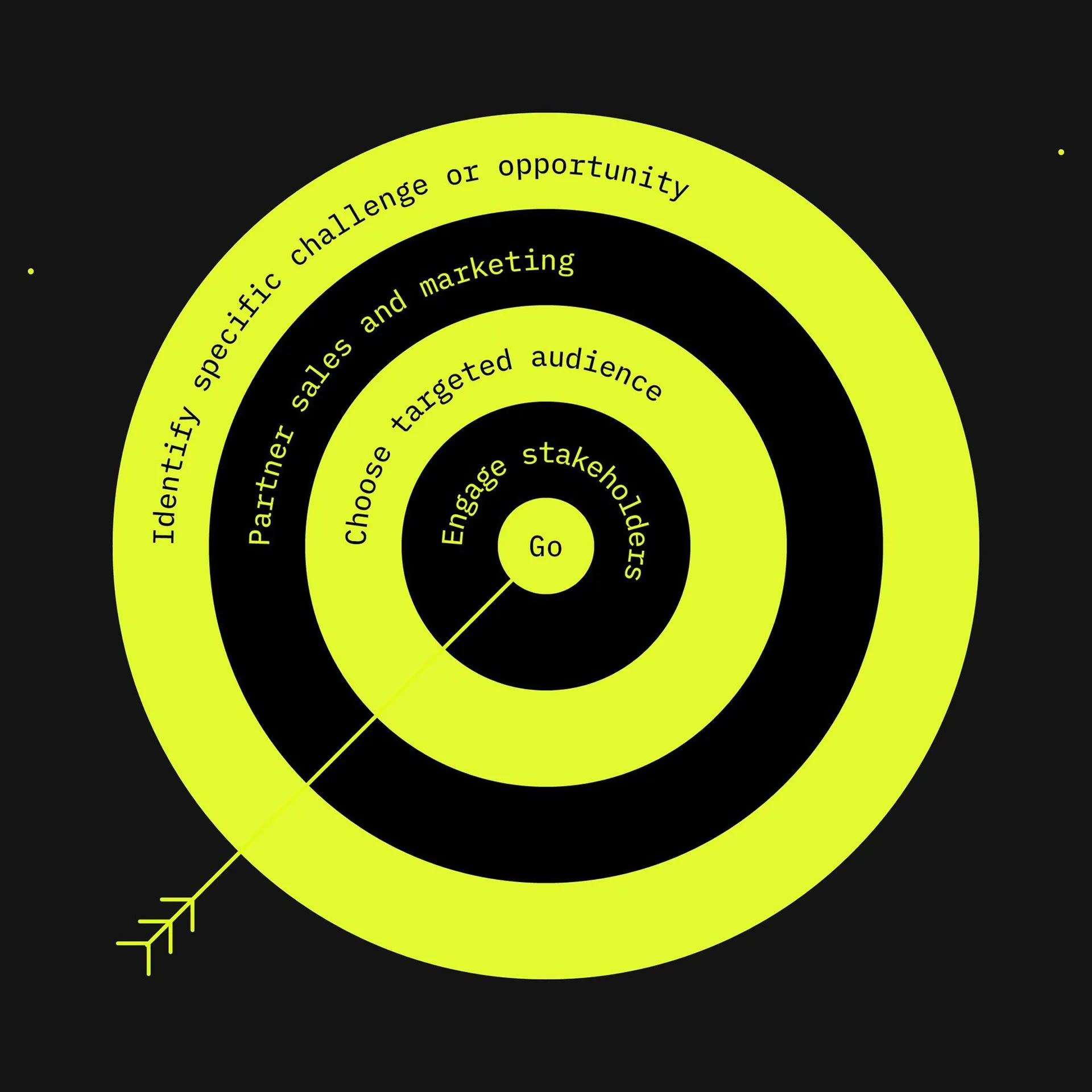
Concentric target diagram with an arrow hitting the bullseye, featuring steps from the outer ring to the center: Identify specific challenge or opportunity, Partner sales and marketing, Choose targeted audience, Engage stakeholders, and Go at the center.

Use ABM for a specific account problem

ABM is appropriate when a priority account has a specific challenge or opportunity that needs more focused attention than broad marketing can provide. Examples include lost momentum in an established account, a message that is not landing with particular buyers, or a significant opportunity requiring a proposition tailored to the customer's requirements.

Content engagement alone is not enough to justify another campaign. Establish whether the account needs better access to influential people, clearer communication of business value, or something communication cannot resolve on its own. Budget constraints, procurement requirements and practical evaluation needs remain separate considerations. A larger buying group is not automatically a problem, and a stalled opportunity does not by itself establish that an internal champion is missing.

Sources: Understanding ABM in five steps

Build the programme around sales insight and stakeholder needs

A focused ABM programme starts with sales and marketing working together, rather than marketing adding activity around an account in isolation. Sales contributes account knowledge and relationship insight; marketing uses that understanding to develop relevant communication. The audience is the buying committee, not simply the contact already responding to content.

The campaign sequence described in Understanding ABM in five steps begins with account selection and stakeholder mapping. Account insights and key themes then inform account-relevant messages and content, followed by stakeholder engagement and measurement of account progress. Messages should address specific business and role-based challenges. This provides a basis for reaching beyond existing contacts while maintaining a shared account proposition, rather than treating every stakeholder as an unrelated audience.

Sources: Understanding ABM in five steps

Use agency support to address a creative or communication gap

Agency support is most relevant when the account programme needs proposition development or creative execution that complements sales knowledge. It should not replace the sales and marketing partnership needed to understand the account. The decision is therefore about the missing capability, rather than choosing an agency instead of the sales team.

For IBM Garage, IBM asked The Frameworks to develop a value proposition and creative concept for its co-creation space. The resulting Where it happens campaign used an interactive physical book and in-browser virtual reality experiences to introduce prospective clients to the environment. That work illustrates a communication and experience-design contribution. It does not establish that an agency is necessary for every priority account, or that creative work can remove budget and procurement barriers.

Sources: IBM Garage: Account-Based Marketing Campaign, Understanding ABM in five steps

Separate account progression from engagement and attribution

Assess an ABM programme through account progress as well as engagement. An account can consume content without moving toward a commercially viable decision, so interaction should not be treated as proof of opportunity progression. Keep opportunity creation, progression and wins distinct when assessing the programme.

The IBM Garage campaign reported 1,200 organic microsite visits, twice the average IBM page engagement rate and $62 million in lead progression within five months. These are reported campaign results, not a controlled comparison with broad marketing. They do not isolate the contribution of account-specific messaging from account selection or sales activity. For an ABM pilot, the relevant proof question is whether commercial movement exceeds what comparable accounts and existing sales effort would otherwise have produced.

Sources: IBM Garage: Account-Based Marketing Campaign, Understanding ABM in five steps