AI made breakthroughs this month in two very different fields. Each achievement was dramatic in its own way, but reactions among interested parties couldn’t have been more different. One group arched a collective eyebrow and went to the pub; the other found itself in an existential crisis.
Both reactions made me reflect – not for the first time – on the enduring role of human imagination. On the ways we seek to challenge ourselves, and in how we solve business and marketing problems.
Puzzled silence
The raised eyebrows came from the crossword-solving community – and I was among them.
Every October, solvers from all over the world descend on News UK’s London HQ to take part in The Times Crossword Championship. It’s a rare chance to turn what’s usually a solitary pastime into a competitive activity, putting our cryptic solving skills to the test under exam-like conditions.
This year’s championship felt like something of a watershed. For one thing, serial champion Mark Goodliffe surprised everyone – apart from himself – by failing to win. The crown passed to the youngest ever winner, Liam Hughes, one of two people under 30 who made the final five. The other, Chloe Hutton, finished fastest but made a single heartbreaking mistake.
My own placing of equal 27th was a personal best, but I can’t claim to have shaken up the dominant middle-aged male demographic of the field in quite the same way.
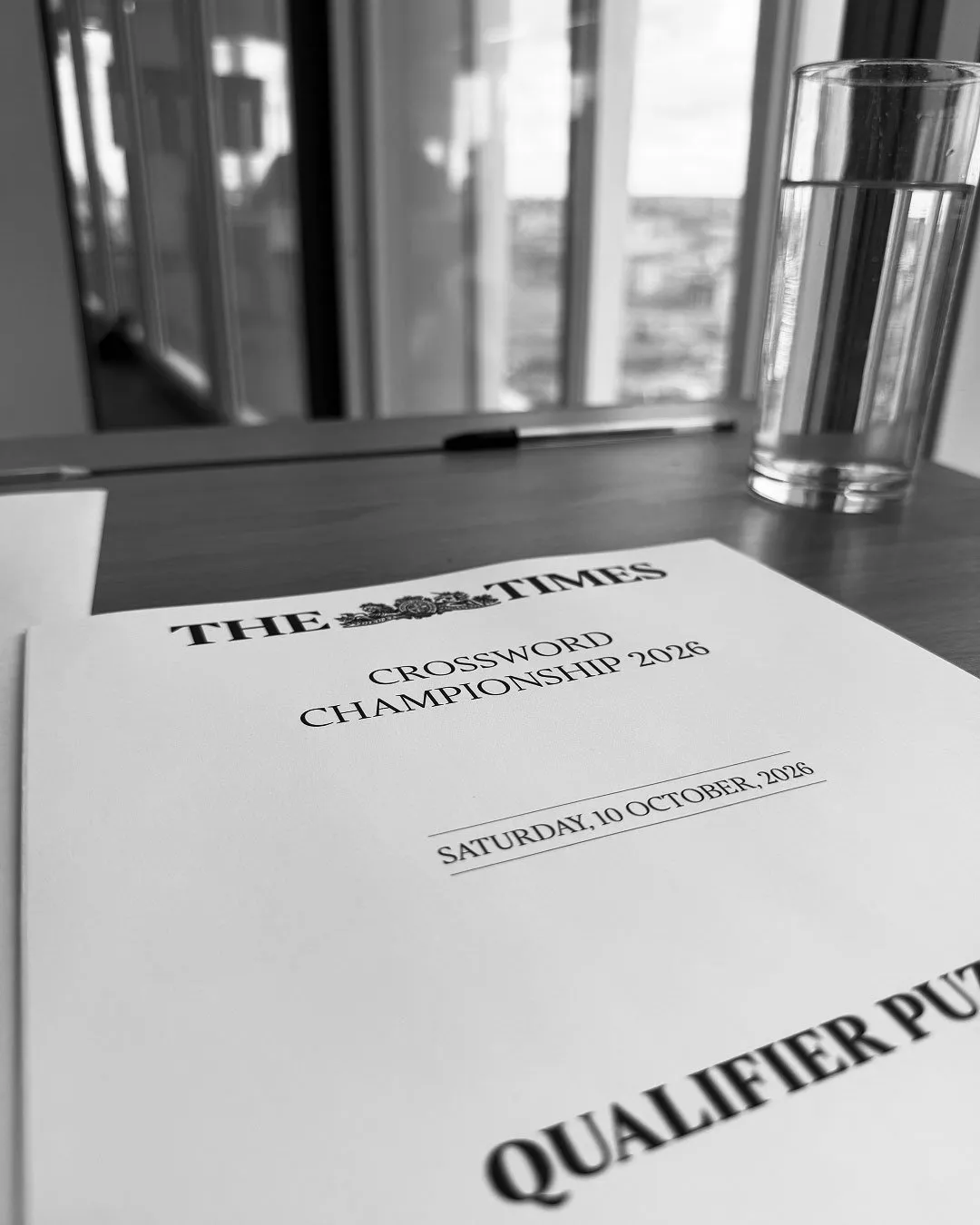
2026 was also the first year Darmok, an AI specially trained to solve cryptic crosswords, outperformed everyone in the room. Last year, it couldn’t even finish all the puzzles.
Darmok’s creator, Dr Siddhartha Chatterjee of the University of Texas, was naturally pleased with the result, putting it down to improvements in the underlying LLMs rather than any new prompt engineering on his part. He also said he had proven it could be done and wouldn’t be bringing Darmok along next year.
Fair to say the people in the room were more excited about the changing of the human guard than AI’s quiet triumph.
100 per cent proof
The world of maths, on the other hand, reacted rather more seismically when AI showed it could solve a different type of puzzle better than humans, too. In what some are calling a “proof dump”, OpenAI released a huge batch of new mathematical results produced by an unreleased internal model: 722 manuscripts, many resolving conjectures that have foiled professional mathematicians for decades.
The reaction has been a combination of scientific excitement – one mathematician said that a particular breakthrough related to the Riemann Hypothesis would have won a human the Fields Medal, the closest maths has to a Nobel Prize – and professional unease.
Hugo Duminil-Copin, a Fields Medal winner himself, said his entire area of research had been eliminated; he had cried so hard at the news that he’d woken his daughter. He compared it to an experienced mountaineer learning that all future ascents would be made by helicopter.
Others have been more optimistic. Marcus du Sautoy, Simonyi Professor for the Public Understanding of Science at the University of Oxford, has used AI to disprove a conjecture he’d been working on since his PhD supervisor challenged him with it 40 years ago – but said the effect had been to reinvigorate his research, not plunge him into despair.
Still, the prevailing reaction in mathematics has been shock at a tsunami of proofs that no-one was expecting or asking for. Marketing professionals who have watched AI-generated content pile up faster than anyone can read it will recognise the frustration: volume doesn’t necessarily equate to value.
What does seem clear, though, is that AI has changed the game in maths. Terence Tao, another Fields Medallist, said in an interview on the Numberphile YouTube channel: “We’re seeing the end of the romantic era of mathematics – the age of heroes.” And it certainly feels like lone crusaders spending half their lives wrestling with a single problem in number theory may be a thing of the past.
What’s the problem?
But just because there are new, faster pathways to solving a problem, that doesn’t mean the problem’s not worth solving. It may be that the real value lies in articulating the problem in the first place – and that is still rich human territory. Albert Einstein is (almost certainly wrongly) quoted as saying that if he had an hour on a problem he would spend the first 55 minutes thinking about the problem itself.
And so back to crosswords and the real reason why no solvers seemed to care too much about losing out to AI. The answer is that as long as the puzzle mountains are still there, we’ll happily enjoy the climb. The climb was always the point.
Much of that happiness comes from the craft and imagination that goes into the clues themselves. And that’s where AI still struggles. Take this clue:
Great low churning could saturate (8)
For those who don’t know, a cryptic clue pretty much always comprises a definition of the answer – usually at the beginning or end of the clue – and some kind of wordplay: a recipe based on a number of cryptic conventions, that will get you to the same answer.
This clue is Claude’s attempt at a clue for the word WATERLOG. We’re being asked to anagram the letters of “great low” by “churning” them and thus find a word that means “saturate”. It’s not a great clue, partly because the word “could” isn’t really a valid grammatical link between the two parts of the clue, but mostly because there’s no elegance to the surface reading of the clue itself. Claude said it was somehow evoking a weather forecast. I don’t buy it.
Contrast Claude’s effort with this clue from the final puzzle of the championship, set by regular Times compiler James McGaughey:
Drench two jerks with lager (8)
It’s basically playing a very similar anagram game. In this case the word “two” is being “jerked” with “lager” to arrive at a word that means “drench” – WATERLOG once again. But here there are no wasted words at all and the surface reading is smooth, elegant and funny, conjuring as it does a scene outside a dodgy bar on a Friday night. This is exactly what a good clue should do: misdirect you with a diverting surface reading while being scrupulously fair in its underlying direction.
Say what you mean
This creativity and craft goes right back to the pioneering cryptic crossword playbook Ximenes on the Art of the Crossword, which includes a quote from early crossword legend Alistair Ferguson Ritchie (known in crosswordland as Afrit): “I need not mean what I say, but I must say what I mean.” The best brand messaging often draws on exactly this combination of playfulness and authenticity.
So yes, AI can solve a fiendishly hard crossword faster than a human champion. And it can make mathematical breakthroughs that humble human practitioners. And, yes, it can churn out marketing copy and generate images that may make writers and photographers fear for their future too.
But imagination and craft still live on. Who decides where to focus? What problems to solve or what content to create? Whose judgment maintains quality? Who is best placed to anticipate how a human audience (or solver) will respond? These are mountains AI doesn’t know how to climb.
Darmok won’t be back next year. But I will be.