What makes AI guidance useful to B2B buyers researching complex services?

AI guidance is useful when it helps buyers identify relevant challenges, find trusted expertise and receive recommendations that can be understood and checked. It should be grounded in structured, evidence-based knowledge rather than generic outputs or opaque inference. Human oversight, clear boundaries and accurate source material help preserve buyer confidence.

Useful AI guidance starts with relevant, trustworthy expertise

For complex B2B services, AI guidance should help a buyer move from a specific question or challenge to relevant expertise. That requires more than placing existing website content behind a conversational interface. Knowledge needs to be organised as clear, evidenced units that explain individual ideas, their relationships and the sources that support them.

This approach makes it easier for an AI system to retrieve and connect the right material without losing the detail of a broader brand story. It also addresses the way buyers increasingly ask detailed, contextual questions rather than browse generic solution pages. A useful experience should respond to those questions with authoritative information that reflects what the organisation can genuinely demonstrate, rather than a broad answer assembled from disconnected content.

Sources: The Prompt: Your brand content is losing you AI search – but it could be the solution

Combine flexible AI with rules, trusted content and human review

AI can make guidance more responsive by identifying a user's challenges, asking tailored questions and connecting them with relevant recommendations. However, flexibility needs limits. Trusted content sources, structured rules and human oversight help keep recommendations accurate, relevant and aligned with the expertise being presented.

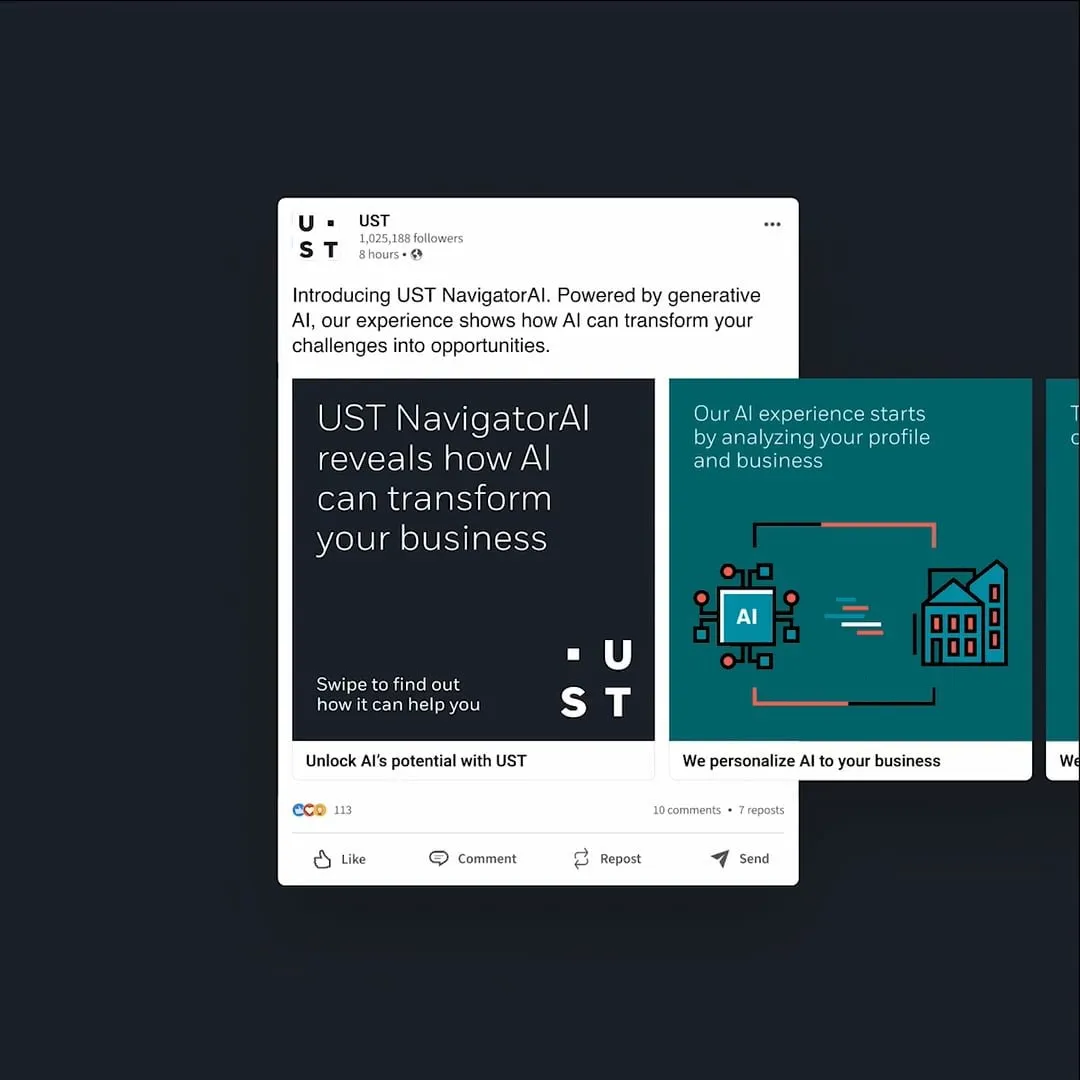
For UST, NavigatorAI was designed to help prospects navigate an extensive body of AI expertise. The experience used generative AI to identify user-specific challenges, guide prospects through tailored questions and produce recommendations informed by UST's AI playbook and expertise. Publicly available business and audience data helped shape each journey, while human input covered prompt design, optimisation and supporting content. The experience was also integrated with HubSpot to capture first-party data for future engagement.

Sources: UST NavigatorAI: Creating personalised experiences with generative AI

Design for changing questions and multiple levels of expertise

A B2B buyer journey rarely follows one fixed persona or one uniform level of knowledge. Different people may need different levels of detail, have different practical concerns and enter the decision at different points. AI guidance is more useful when it responds to the question being asked while making room for those differences.

That means understanding what audiences are trying to solve, not relying only on assumed profiles or anonymous data. Input from sellers, social profiling and observation of competing experiences can improve that understanding. Content can then present practical challenges before abstract features, and offer layers of detail for people with different expertise or available time. AI should support this navigation, not replace the judgement needed to decide when a human conversation, deeper source material or a different experience is more appropriate.

Sources: Humanising B2B and leading with empathy, The Prompt: Your brand content is losing you AI search – but it could be the solution, The Prompt: Are your brand guidelines ready to deliver behaviour?

Stats

A Gartner survey of 1,464 buyers and consumers found that 53% said personalization made their experience worse.

Gartner

Forrester reported that 19% of B2B buyers using generative-AI applications felt less confident in purchase decisions because information was inaccurate or unreliable.

Forrester

Forrester reported that 95% of B2B buyers planned to use generative AI in at least one area of a future purchase.

Forrester

FAQs

What makes AI recommendations feel intrusive to B2B buyers?

AI recommendations can feel intrusive when they appear overly personal, irrelevant or unexplained. A better approach is to use information that supports a clearly useful journey, explain the role of AI where appropriate, and avoid presenting the system as human when a direct, transactional interaction is more suitable. Personalisation should be guided by relevance and respect for the user's context.

What causes inaccurate AI answers during B2B research?

Inaccurate AI answers can result when knowledge is fragmented across pages and documents, when relevant evidence cannot be retrieved, or when content is inconsistent or outdated. An AI system may then struggle to connect information or represent the organisation accurately. Structured, authoritative knowledge and human oversight reduce those risks.

How can B2B buyers check where an AI answer came from?

B2B buyers can check an AI answer by looking for the underlying evidence, source material and a clear explanation of what supports the recommendation. Organisations can make this easier by tracing ideas back to their original sources and establishing a definitive, evidence-based view of important topics. Where the answer is uncertain or consequential, buyers should be able to seek human expertise or review more detailed material.

What does AI guidance miss in a buying committee?

AI guidance can miss the different needs, levels of expertise and decision contexts represented across a buying committee. One person may need a concise practical explanation, while another needs technical depth or validation from an expert. The experience should therefore offer different layers of information and avoid treating one inferred persona as the whole decision-making group.

How do I tell whether AI guidance adds value to a B2B buyer journey?

AI guidance adds value when it helps buyers find relevant expertise, understand their challenges and progress with greater confidence than a generic journey would allow. Assess whether recommendations remain aligned with trusted content, whether users can access the right level of detail and whether human oversight protects accuracy. Compare the experience with existing search, content and expert-led routes rather than relying only on interaction volume.

How do I build a reliable AI guidance experience for B2B buyers?

Build the experience around trusted knowledge, relevant buyer questions and clear human-led controls.

  1. Organise the knowledge

    Identify the expertise buyers need and bring together the strongest evidence that supports it. Structure each subject as a clear, cohesive unit, including its relevant relationships and original sources. Resolve contradictions, gaps and duplication before using the material for AI guidance.

  2. Design around real questions

    Map the practical questions, challenges and contexts that different buyers bring to the journey. Use this understanding to guide questions, recommendations and layers of detail, rather than relying only on fixed personas. Present information in terms that help users assess a real problem.

  3. Set boundaries and review

    Define the trusted sources, rules and human review needed to keep recommendations accurate and useful. Decide where AI can provide efficient guidance and where a human should take over. Review prompts, outputs and supporting content so the experience remains aligned with the intended expertise and brand behaviour.