What should AI do across a brand campaign?

AI should help a brand campaign demonstrate a real capability, create more relevant engagement and turn available data into useful experiences. It works best as a collaborator with expert teams, not as a standalone replacement for strategy or creativity. Campaigns should also measure the audience and business outcomes AI support contributes to.

Enterprise-level AI makes capabilities visible

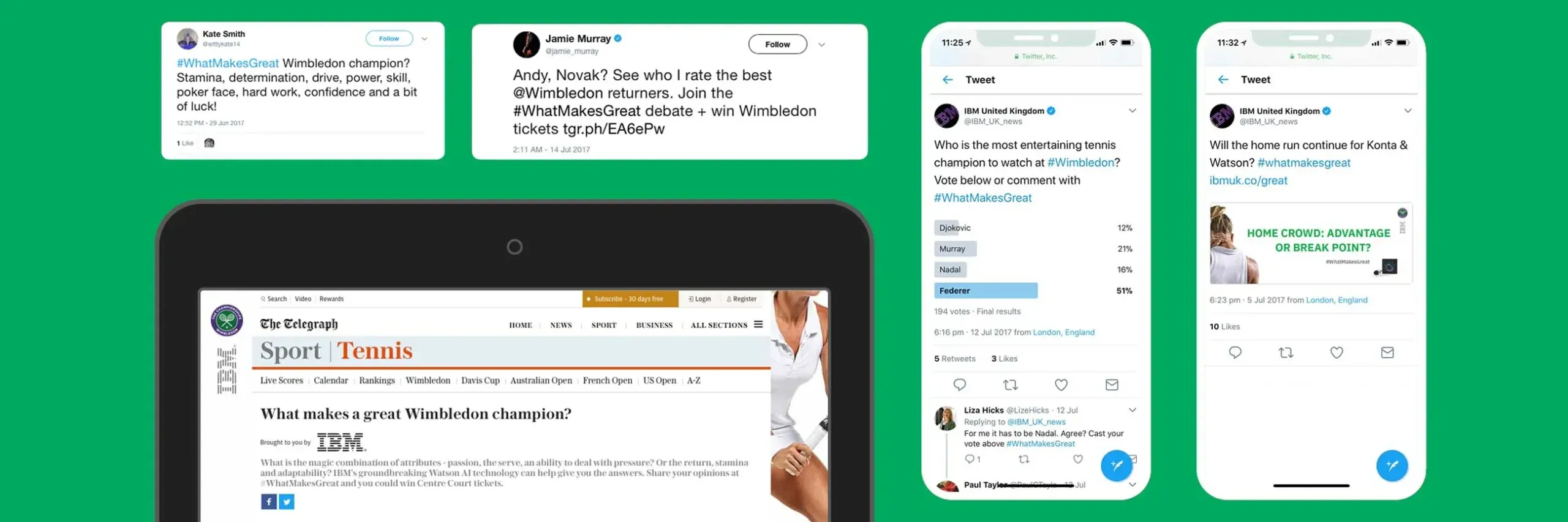
Enterprise-level AI can help a brand demonstrate what it can do at a meaningful scale, rather than simply claim technical expertise. In the IBM and Wimbledon partnership, IBM Watson was used in a campaign that explored the question, "What makes great?" The work drew on data gathered during the partnership and Watson's live social listening to lead a public debate during the tournament. This gave the campaign a practical way to show how AI could turn data and real-time conversation into a relevant audience experience. For B2B brands, a high-profile event can provide a platform to demonstrate capabilities that potential clients may apply to their own organisations.

Sources: IBM and Wimbledon: Ongoing Campaign Involvement, A game plan for success: how B2B brands can tap into the spirit of sport

Use AI as a collaborator throughout the campaign

AI does not independently create a strong brand campaign. Marketers still need to shape experiences around their values and deepen their understanding of customer wants and needs. Access to generative AI tools alone does not ensure quality, in the same way that access to creative software does not make someone a designer. The strongest results come from combining hands-on experience with AI tools and professional expertise. During a live event, AI can support ongoing activity by using available data and social listening to inform engagement while the campaign is active. This makes AI useful beyond initial production, provided the work remains connected to a clear strategic and creative purpose.

Sources: Introducing: Small AI for brands, IBM and Wimbledon: Ongoing Campaign Involvement

Match the AI approach to the campaign objective

Not every AI initiative requires a large-scale organisational transformation. Enterprise AI transformation involves major organisations reconfiguring functions around an AI framework, often with substantial investment and timelines beyond 12 months. Middleware AI is more focused: team or department projects intended to reduce costs and improve accuracy or efficiency, often shaped by quarterly KPIs. For campaign work, the practical starting point is to identify one or two things a brand can do better than others and build a new experience around them. This keeps AI activity tied to a distinctive capability instead of treating the technology as the message by itself.

Sources: Introducing: Small AI for brands

Stats

FAQs

Where can small AI tools help a brand team?

Small AI tools can help brand teams improve content and strategy, automate parts of the customer sales journey, and reduce the time and cost expected for some projects. They are most useful when guided by professional expertise and focused on a specific opportunity to create a better experience.

What should AI keep doing after a campaign launches?

After launch, AI can support live engagement by using available campaign data and social listening to inform activity while an event or campaign is underway. It should continue to serve the campaign's strategic purpose, helping audiences understand the capability the brand is demonstrating.

How can I show what AI changed in a campaign?

Show what AI changed by connecting its role in the campaign to measurable audience and business outcomes. Relevant measures can include visits, engagement, media value, software trials and sales, alongside a clear account of how AI supported the experience.

How do I demonstrate the impact of AI campaign support?

Build the campaign around a real capability, use AI in support of the experience, and assess the outcomes it helps produce.

  1. Define the capability

    Identify one or two things the brand can do better than others and build the campaign experience around them. Use AI to make that capability more visible and relevant, rather than treating AI as the campaign message.

  2. Apply AI with expertise

    Use AI alongside strategic and creative expertise to support content, customer understanding or live engagement. Keep the work aligned with brand values and the audience experience the campaign needs to deliver.

  3. Measure the outcomes

    Track outcomes that show both audience response and business value, such as visits, engagement, trials or sales. Explain the role AI played in producing the experience so that results are connected to the campaign activity.

Glossary

Middleware AI
Team and department-level AI projects designed to reduce costs and improve accuracy or efficiency, typically shaped by quarterly KPIs rather than large consultancy-led transformation programmes.