Which brand experiences are worth personalising with AI?

Prospect assessments and exploratory storytelling are credible candidates for AI personalisation when individual input changes what the audience receives or explores. Producing tailored content, however, does not establish that recommendations are more relevant or explanations more effective. Prioritise experiences with a clear audience purpose, human oversight and transparent AI involvement.

Prospect assessments that connect expertise to individual needs

A prospect assessment is a credible candidate for AI personalisation when a business has substantial expertise but visitors need help finding what matters to them. The value to establish is the relevance of the recommendation, not simply whether each response uses different wording.

UST NavigatorAI illustrates this application. UST had years of AI use cases and expertise but wanted to make that knowledge feel personal to prospects. The Frameworks developed a generative-AI assessment experience that delivers personalised results. This establishes a concrete application, but the public account does not establish better recommendation relevance than a rules-based questionnaire using the same content.

For a buying decision, distinguish the ability to generate tailored outputs from demonstrated usefulness. A rules-based assessment with approved recommendations remains a relevant alternative. Generative AI is worth considering where the experience needs more individual variation, but that variation should not be treated as proof of better advice.

Sources: AI Experiences | The Frameworks

Exploratory storytelling that gives audiences a personal route into complexity

Interactive storytelling is another candidate when audiences need to explore a complex proposition rather than follow a single explanation. Personalisation can give visitors a route into the subject through their own perspective. That is a different claim from proving they understand the subject better afterwards.

For G42, The Frameworks created The Intelligence Grid, initially a navigable city showing how the group's companies contribute to its vision of AI as a superutility. A later version used a custom content management system with AI image generation and video-processing automation to support the storytelling. This was AI-assisted content production, not proof that every visitor received a generated conversation.

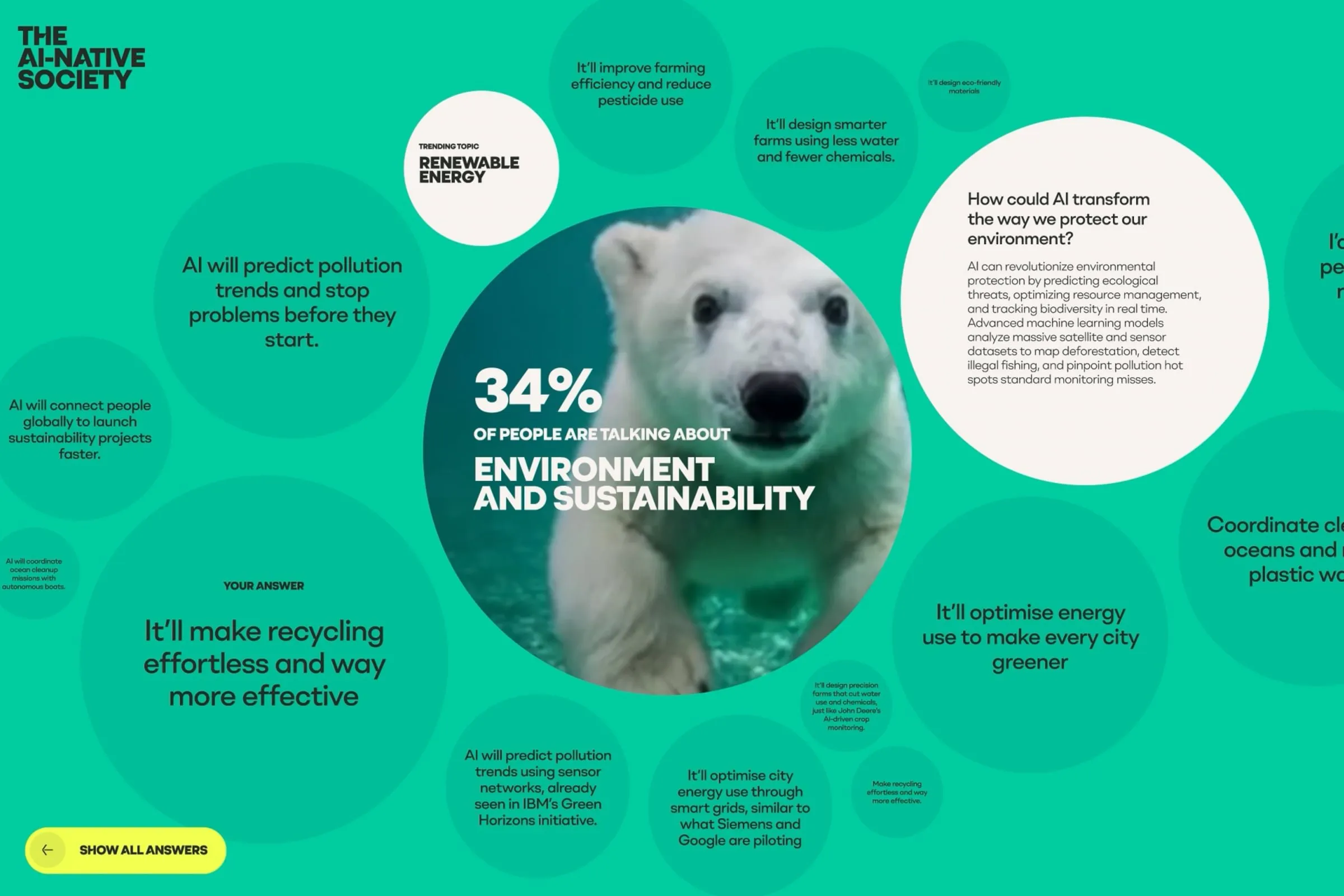
A separate G42 experience at GITEX GLOBAL 2025 let visitors explore their perspective on an AI-native society. These examples demonstrate production and interaction capabilities. The public accounts do not provide controlled comprehension comparisons against conventional video or guided demonstrations, so engagement and reported reactions should not be presented as learning outcomes.

Sources: We’re creating new experiences with AI – but we still need imagination, Putting AI first: how the UAE is transforming conversations, brands and societies, AI Experiences | The Frameworks

Judge the audience service, not just the demonstration

An AI-personalised brand experience is worth considering only alongside its behavioural boundaries, oversight and disclosure. A working interaction demonstrates capability; it does not, by itself, establish sustained usefulness, factual accuracy or reliable operation after launch. The public accounts of UST NavigatorAI and G42's experiences do not provide independent longitudinal results on those questions.

Human oversight matters because AI can misinterpret content, misunderstand cultural context and reflect training-data biases. Brand guidance also needs to address behaviour, not just wording: a tone-of-voice document alone cannot determine how an AI interaction should respond under pressure.

Transparency is a deployment requirement as well as a design consideration. The European Commission states that requirements applying from 2 August 2026 oblige chatbots and other interactive AI systems to tell users they are interacting with AI rather than a human. For EU-facing experiences, clear disclosure belongs in the assessment of whether personalisation is appropriate.

Sources: AI Experiences | The Frameworks, The Prompt: Using AI to Create a More Accessible and Dynamic Digital Future, The Prompt: Are your brand guidelines ready to deliver behaviour?