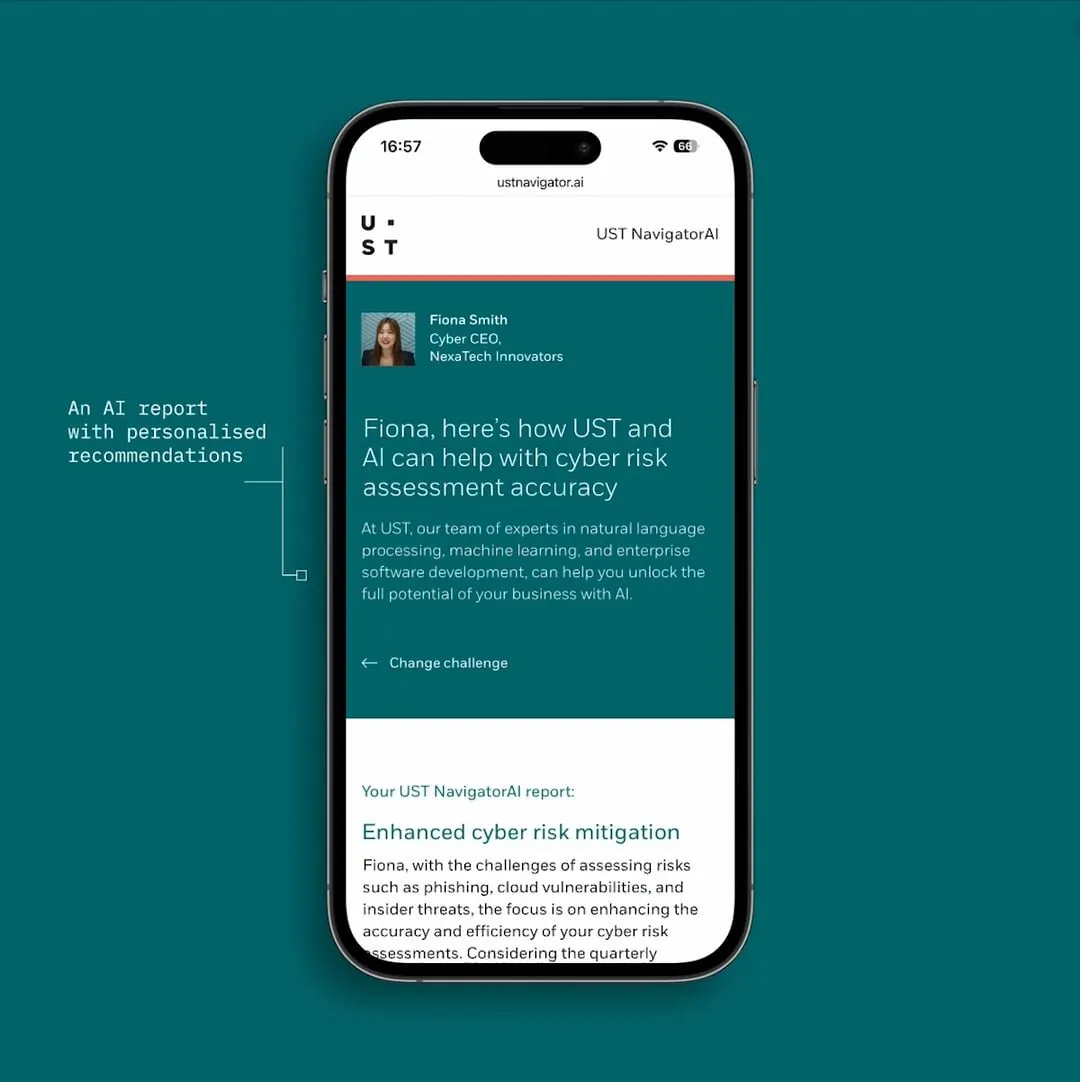
How do we personalise recommendations from our B2B assessment tools?

Personalise B2B assessment recommendations around each prospect's circumstances, challenges and responses, using trusted expertise and structured rules to keep advice relevant. Use generative AI where flexible questions and responses add value, rather than assuming every assessment needs it. Review recommendations with subject-matter experts and use prospect feedback to improve the experience.

Connect prospect circumstances with trusted expertise

Personalised B2B recommendations need more than different wording for the same output. The assessment should connect a prospect's circumstances and challenges with expertise that addresses those needs. Useful inputs can include business context, audience characteristics and responses to questions, provided they help determine which advice is relevant.

UST's NavigatorAI illustrates this approach. UST had an extensive library of AI expertise, but prospects struggled to find the resources most relevant to them. NavigatorAI uses generative AI to identify user-specific challenges, guide prospects through tailored questions and generate recommendations informed by UST's AI playbook. Publicly available business and audience data help shape the journey.

The important design choice is the combination of flexibility and constraints. NavigatorAI combines generated content with structured rules, proprietary expertise and human oversight. For a B2B assessment, personalisation should change the substance of the recommendation while keeping advice aligned with what the business can support.

Sources: UST NavigatorAI: Creating personalised experiences with generative AI

Choose the simplest experience that meets the buyer's need

Generative AI is one approach to personalised B2B engagement, not a requirement for every assessment. A configurator can help prospects understand how a defined solution fits their business. A layered content experience can let readers choose the depth they need. Generative AI can support more flexible questions and recommendations when circumstances vary beyond a predefined journey.

Dematic's Micro-Fulfillment configurator used a brief set of questions and formulated logic to help customers understand the solution, while collecting information to inform sales discussions. Siemens Digital Industries Software took a different approach: an interactive content journey offered detailed technical papers or executive summaries, allowing users to control complexity.

UST's NavigatorAI generated recommendations around individual challenges. These projects demonstrate different design choices, not a comparative performance ranking. Start with the buyer's information need, then decide whether structured logic, adaptable content or generated advice is the appropriate response.

Sources: Dematic Micro-Fulfillment: A Simple, Powerful Engagement Tool, Siemens: Bringing New Dimensions to White Papers, UST NavigatorAI: Creating personalised experiences with generative AI

Make the assessment a useful exchange

A B2B assessment should give prospects something useful in return for the information they share. That might be an answer about their business, a report, expert advice or a clearer understanding of a suitable configuration. Data collection should serve that exchange rather than become the assessment's only purpose.

Hiscox's cyber exposure calculator makes the exchange concrete. Businesses gain a clearer picture of their cyber risk and the monetary value of their exposure. Hiscox receives a company security profile, including size, industry and security capabilities, that helps it understand potential insurance needs.

The same principle supports ongoing improvement. Prospect inputs and interactions with questions create feedback loops that can inform changes to the tool and more tailored content. UST's NavigatorAI also integrates with HubSpot to capture first-party data and support future engagement. These mechanisms provide useful audience information; they do not, by themselves, establish improved pipeline performance.

Sources: Everyone’s a winner: exchanging value in B2B marketing, UST NavigatorAI: Creating personalised experiences with generative AI

Test recommendation usefulness separately from engagement

A responsive assessment is not necessarily a useful adviser. Before extending a personalised B2B experience, compare it with the existing journey and examine whether recommendations address meaningful differences between prospects. Subject-matter experts should review the advice, while prospects should be able to judge its relevance and retain control over how much detail they explore.

UST's NavigatorAI combines tailored responses with structured rules and human oversight. Siemens Digital Industries Software's interactive experience gives readers control over technical depth. These are practical design approaches, but neither project establishes that generative AI outperforms rules-based assessments or expert consultation.

Keep commercial evaluation separate from recommendation review. Assess qualified leads and downstream value rather than relying on interaction volume alone. Where buyers need validation, provide access to a sales conversation rather than treating an assessment as the final decision. Dematic's configurator shows how prospect information can help inform those discussions.

Sources: UST NavigatorAI: Creating personalised experiences with generative AI, Siemens: Bringing New Dimensions to White Papers, Dematic Micro-Fulfillment: A Simple, Powerful Engagement Tool

Stats

Gartner found that 69% of B2B buyers preferred to validate AI-generated insights with sales representatives.

Gartner

FAQs

When should we use AI in our B2B assessments?

Use generative AI when a B2B assessment needs to adapt questions and recommendations to individual circumstances beyond a predefined journey. UST's NavigatorAI does this using user-specific challenges, UST's AI playbook, structured rules and human oversight. A defined product-fit task may instead suit a configurator, as Dematic's Micro-Fulfillment experience demonstrates; these projects do not establish that AI is universally more effective.

What should prospects get from our B2B assessments?

Prospects should receive a useful answer to a business challenge in exchange for the information they share, such as tailored advice, a report or a clearer understanding of their needs. Hiscox's cyber exposure calculator gives businesses a clearer picture of cyber risk and the monetary value of their exposure. UST's NavigatorAI provides personalised recommendations informed by individual challenges and UST's AI expertise.

How can B2B assessments support more targeted marketing?

B2B assessments can support more targeted marketing by collecting prospect information and revealing how people interact with questions, which can inform tool improvements and more tailored content. UST's NavigatorAI integrates with HubSpot to capture first-party data and support future engagement. Dematic's Micro-Fulfillment configurator collects customer information to help generate prospective leads and inform sales discussions, although data capture alone does not prove better conversion.