Why do priority B2B deals stall when more people join the decision?

Priority B2B deals often stall when established relationships do not extend to enough influential people in the account. A focused account-based marketing programme can help sales and marketing map the buying group, develop role-specific messages and content, and track whether the account is progressing. It should support, rather than replace, clear sales follow-through and commercial conversations.

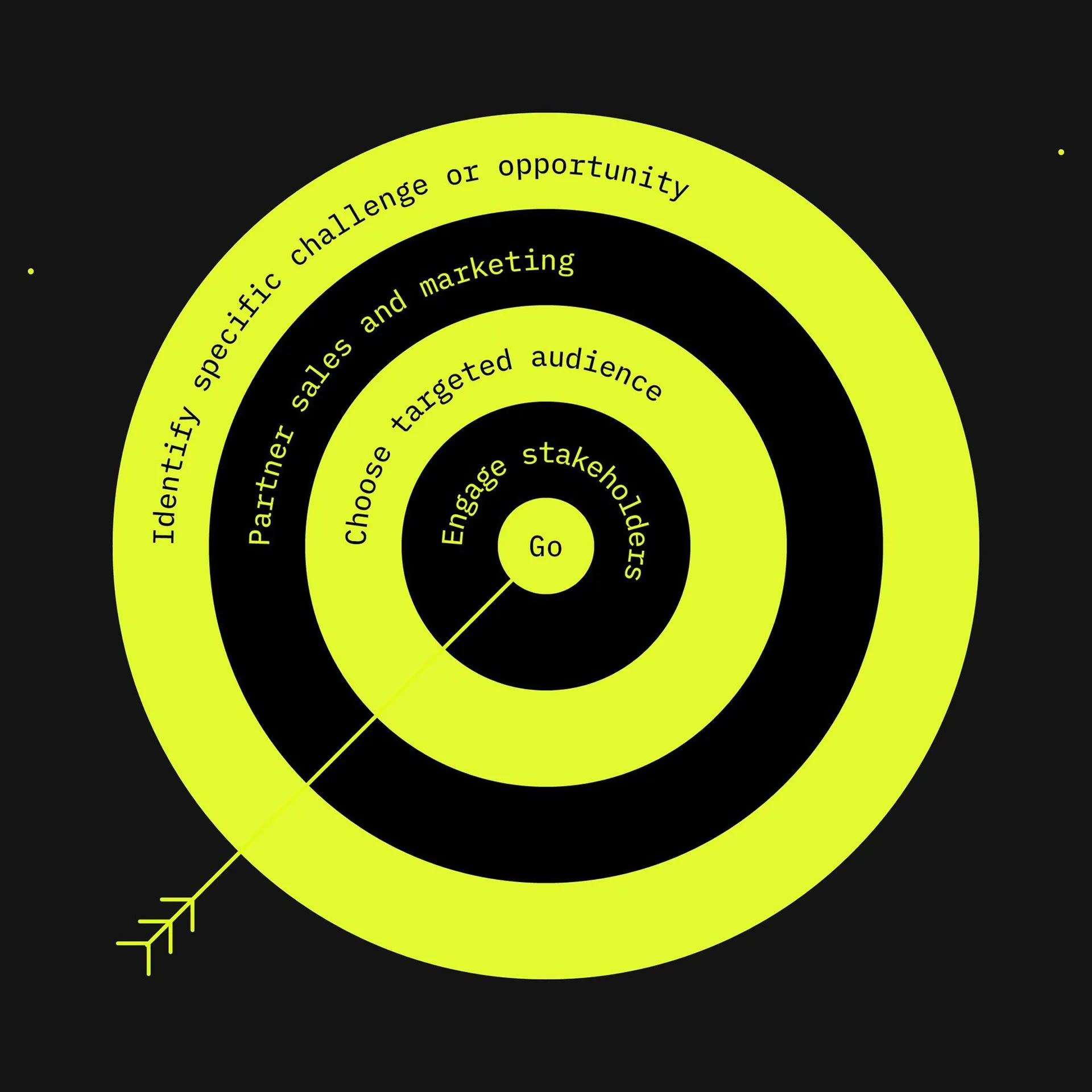
Concentric target diagram with an arrow hitting the bullseye, featuring steps from the outer ring to the center: Identify specific challenge or opportunity, Partner sales and marketing, Choose targeted audience, Engage stakeholders, and Go at the center.

A champion is not the whole buying group

A priority account can lose momentum even when the original contact is engaged. Sales teams may have account plans, meetings and relationships, yet still fail to reach enough of the people who influence the decision. In a complex B2B purchase, the relevant audience is the buying committee, not simply the first person who responded to outreach.

This is where account-based marketing can be useful. Rather than casting a wide net, it focuses on a specific account or small group of accounts that matters strategically. The work begins by identifying who is involved in the decision and understanding the business and role-based challenges that matter to them. That creates a clearer basis for sales and marketing to work together around one account, rather than treating engagement from one friendly contact as evidence that the whole opportunity is moving forward.

Sources: Understanding ABM in five steps, Account-Based Marketing | The Frameworks

Map stakeholders before creating account content

Stakeholder mapping is an early part of an ABM campaign because it turns a vague account relationship into a practical view of who needs to be reached. Start by selecting the account and identifying the people involved in its buying committee. Sales insight can help marketing understand existing relationships, while marketing can turn those insights into a targeted communications programme.

The next task is to develop account insights and key themes. Those themes should inform messages that address the distinct business and role-based challenges of the people involved, rather than repeating a single generic proposition. The campaign can then engage stakeholders over time and measure account progress. This makes it easier to see whether marketing is helping create broader access and understanding, or whether the account needs a different intervention beyond communications.

Sources: Understanding ABM in five steps, Account-Based Marketing | The Frameworks

Give each buyer something useful to assess

Account-specific content is most useful when it helps different people understand a complex offer in terms relevant to their work. Meaningful messages should address the business and role-based challenges of the buying committee, not simply add an account name to generic campaign materials. For a technical or operational audience, a clear explanation of how an offer works may be more valuable than broad brand messaging. For senior stakeholders, the emphasis may need to be on the strategic problem and intended business value.

Interactive content can also create a value exchange. Calculators, assessment tools and configurators can give prospects an answer, report or personalised view of a service while revealing information that can improve subsequent conversations. Dematic used a configurator to help customers understand how its Micro-Fulfillment solution could work for their business and to inform sales discussions.

Sources: Understanding ABM in five steps, Everyone’s a winner: exchanging value in B2B marketing, Dematic Micro-Fulfillment: A Simple, Powerful Engagement Tool

Stats

Gartner research reported that 74% of B2B buying teams experienced unhealthy conflict during the decision process.

Gartner

Forrester's 2024 ABM research found that respondents most commonly reported ABM ROI being 21% to 50% higher than non-ABM marketing.

Forrester

A 2025 Gartner survey reported that 53% of B2B buyers and consumers experienced negative outcomes from traditional personalisation.

Gartner

FAQs

What makes different buyers disagree on a B2B purchase?

Different buyers can disagree when the purchase is viewed through different business and role-based challenges. A relationship with one contact may not provide access to enough influential people to build shared understanding across the buying committee. Stakeholder mapping helps identify who needs to be engaged and what information each person needs.

What messages help a buying group agree on a B2B purchase?

Messages that address specific business and role-based challenges are more useful than one generic proposition for every stakeholder. Account insights and shared themes can provide a consistent foundation, while the content for each audience should help them understand the offer in relation to their responsibilities. The aim is coordinated understanding across the account, not simply more campaign activity.

What makes B2B personalisation feel intrusive to buyers?

B2B personalisation can feel intrusive when it appears inaccurate, superficial or unrelated to a buyer's actual work. Referencing an account without providing useful information does not create value. More credible personalisation starts with a clear understanding of the buyer's role, challenges and the questions they need answered.

What content helps technical and business buyers assess a B2B purchase?

Technical and business buyers benefit from content that makes a complex offer clear in relation to their own needs. Role-specific messaging, explainers and interactive tools such as calculators, assessment tools and configurators can help prospects explore how an offer applies to their business. These formats can also generate information that improves later sales discussions.

How do I plan content for a B2B buying group?

Plan account content around the people involved in the decision, the questions they need answered and the account progress you need to assess.

  1. Map the buying group

    Identify the people involved in the target account's decision and the influence they have on it. Use sales insight to understand current relationships and gaps in access. Treat the buying committee as the audience, not just the original contact.

  2. Build role-specific themes

    Develop account insights and key themes before producing content. Translate those themes into messages that address the business and role-based challenges of different stakeholders. Keep the underlying proposition consistent while making each communication useful to its intended audience.

  3. Create value and track progress

    Use clear content or interactive experiences that help buyers assess how the offer could apply to their business. Review stakeholder engagement and account progress throughout the campaign. Use what you learn to refine the content and support more informed sales conversations.