What content helps a stalled B2B buying group reach a decision?

Content helps a stalled B2B buying group when it addresses shared business challenges, gives each stakeholder relevant reasons to act, and creates a coherent case for the account. Build the campaign from account and stakeholder insight, then use sales and marketing together to engage the group and track account progress.

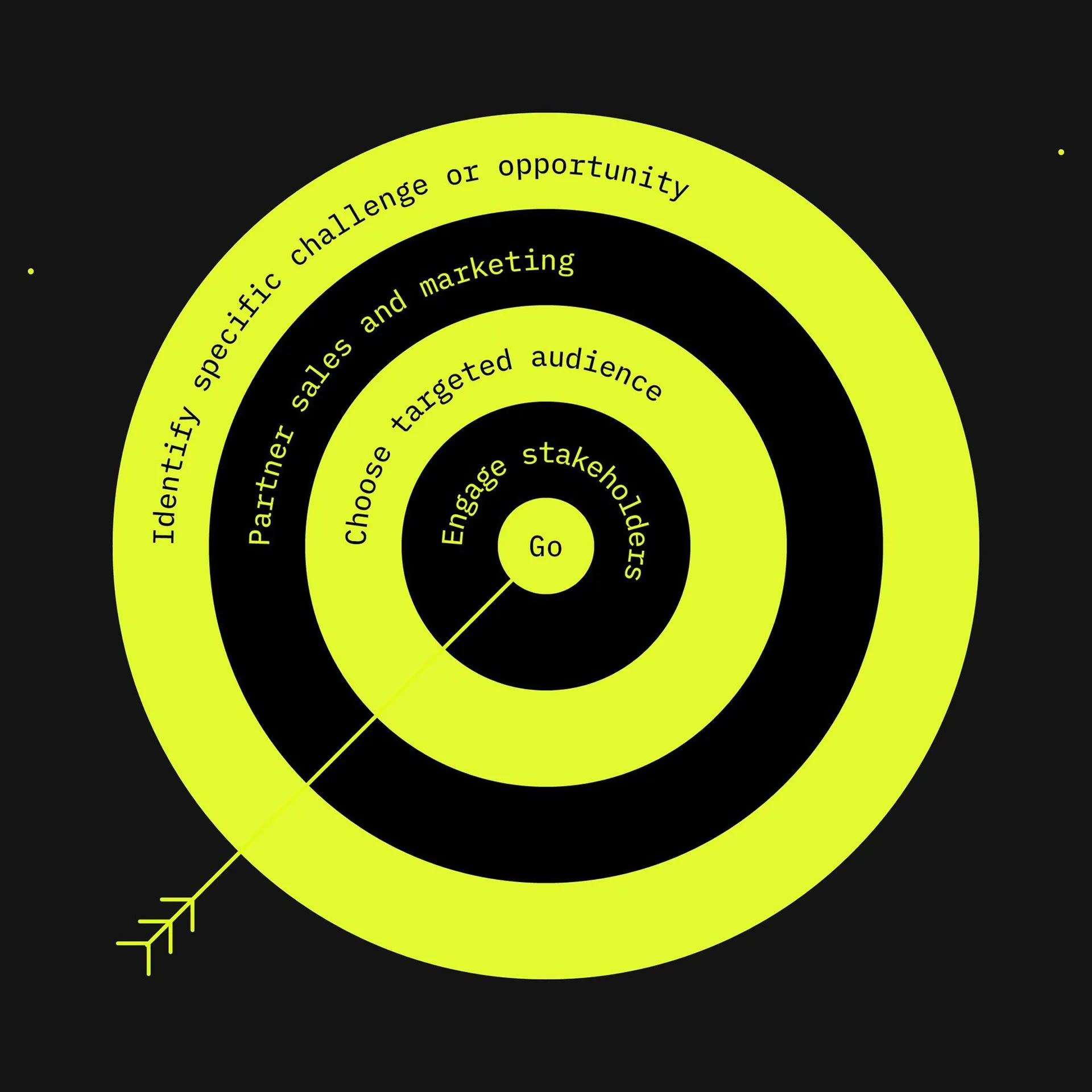
Concentric target diagram with an arrow hitting the bullseye, featuring steps from the outer ring to the center: Identify specific challenge or opportunity, Partner sales and marketing, Choose targeted audience, Engage stakeholders, and Go at the center.

Build content around the buying group, not a single persona

A stalled account often reflects a gap in influence, not simply a lack of product information. Account-based marketing, or ABM, is designed for a specific target account or a small group of accounts where there is a meaningful commercial challenge or opportunity. It starts with close collaboration between sales and marketing, because sales insight can identify the people, relationships and account context that marketing needs to build a relevant campaign.

The audience is typically the buying committee. Rather than using broad messages or assumptions based only on job titles, map the stakeholders and identify the business and role-based challenges they need to resolve. Research should explore what matters to the audience, where they get information and which wider market pressures affect their decisions. This creates a basis for messages that help people inside the account discuss the same problem, rather than receiving disconnected communications.

Sources: Understanding ABM in five steps, How to Turn Insights into Great Creative

Turn account insight into a campaign that supports a decision

An ABM campaign generally begins by selecting the accounts and mapping stakeholders. Those inputs inform account insight and key themes, which then shape messaging and content relevant to the account. The campaign should engage stakeholders across its timeline, rather than relying on a single asset or isolated contact point.

For complex propositions, content needs to make the business case accessible without losing the substance of the offer. Siemens reframed technical reports for business leaders as well as technical audiences by drawing out business benefits in concise copy across an interactive web experience. Dematic similarly used a digital configurator to help customers understand how its Micro-Fulfillment solution could work for their business, while collecting information that could support prospective leads and sales discussions. Useful content can therefore explain the offer, invite participation and give commercial teams better context for the next conversation.

Sources: Understanding ABM in five steps, How to Inspire Decision-Makers to Be Bold, Dematic Micro-Fulfillment: A Simple, Powerful Engagement Tool

Use a shared narrative before individual-level personalisation

Buying-group content should give stakeholders a common frame for evaluating a decision. It can still address different needs, but the underlying problem, priorities and reasons to act need to remain consistent across the account. A campaign built only around individual personas risks making assumptions from job titles and creating messages that do not add up to a shared commercial case.

A clear campaign platform can connect product capability with a larger issue that matters to the audience. IBM's Wize Guys campaign used technology influencers, video, blogs and social content to connect data decision-makers with expert perspectives on data challenges, while positioning IBM storage solutions within that conversation. Wates used a strategic messaging framework built around three complementary ideas, allowing its purpose to work across a diverse audience while remaining joined-up. The objective is not generic content volume, but a credible, consistent story that stakeholders can use to build internal alignment.

Sources: How to Turn Insights into Great Creative, IBM Storage influencer campaign, Wates: Reimagining a Brand with Purpose

Measure progress at account level, not only content activity

Campaign measurement should follow the account journey from engagement to commercial conversation and opportunity progress. ABM guidance emphasises engaging account stakeholders throughout the campaign and measuring account progress, which makes sales and marketing collaboration central to both delivery and evaluation.

Use campaign activity as context, but connect it to signals that matter within the target account: stakeholder engagement, information shared through interactive tools, sales discussions, software trials, leads and revenue where those outcomes can be observed. Dematic's configurator was designed to deepen customer understanding while providing customer information to generate prospective leads and inform sales discussions. IBM's Wimbledon activity linked campaign performance to landing-site visits, engagement, software trials and sales over a three-week period. Attribution will not be perfect, but a clear account-level measurement plan makes it possible to distinguish attention from progress.

Sources: Understanding ABM in five steps, Dematic Micro-Fulfillment: A Simple, Powerful Engagement Tool, IBM and Wimbledon: Ongoing Campaign Involvement

Stats

Gartner found that 74% of B2B buying teams experienced unhealthy conflict during the decision process, while buying-group-framed content improved consensus by 20%.

Gartner

FAQs

What can content campaigns show about pipeline progress?

Content campaigns can show whether an account is moving from engagement towards commercial action, including sales discussions, prospective leads, trials and sales where those outcomes are available. Account-level measurement is more useful than reporting views or impressions alone because it follows stakeholder activity and account progress across the campaign. IBM's Wimbledon work, for example, reported landing-site visits, engagements, software trials and sales.

When does an external content agency add value to an in-house team?

An external content agency adds value when a team needs dedicated audience research, an outside-in view of the market, comparative understanding of competitors or a clearer creative approach. That work can help turn internal knowledge into audience profiles, relevant messages and differentiated communications. The value is strongest when the external team works with sales, marketing and subject-matter stakeholders rather than operating separately from them.

What causes personalised B2B campaigns to split a buying group?

A personalised B2B campaign can split a buying group when its messages optimise for individual interests without supporting a common decision. Stakeholders may receive different priorities, benefits or interpretations of the problem, making internal consensus harder. Use stakeholder insight to tailor relevance, while keeping the central business challenge and campaign narrative consistent for the account.

Where do content campaigns affect sales beyond awareness?

Content campaigns affect sales beyond awareness when they give sales teams account insight, create opportunities for prospects to share useful information and provide material for commercial conversations. Interactive content such as configurators, calculators and assessment tools can create a value exchange that helps a prospect while generating information for more targeted follow-up. Dematic used a configurator both to explain its offer and to inform prospective leads and sales discussions.

What makes complex B2B content credible to hidden decision-makers?

Complex B2B content is more credible when it connects technical capability to a clear business challenge and uses relevant expertise or proof to support the case. Technical detail should remain available, but senior and non-technical audiences also need concise explanations of business benefits. IBM used technology influencers to bring expert perspectives into a thought-leadership stream, while Siemens structured technical content around business benefits for business leaders.

How do I plan a B2B content campaign for a buying group?

Plan the campaign around the account's shared decision, then use stakeholder insight and account-level measures to support progress.

  1. Align sales and marketing

    Start by agreeing the target account, commercial challenge and desired account progress with sales and marketing. Combine sales knowledge of relationships and account plans with marketing's ability to develop relevant messages and content.

  2. Map stakeholders and shared needs

    Identify the buying-group stakeholders and the business or role-based challenges they need to resolve. Build messages around a shared account problem, while making the relevance of the proposition clear to different contributors.

  3. Create, engage and measure

    Develop account-relevant content from the insight, then use it to engage stakeholders over time. Track account engagement, sales conversations and observable opportunity progress so the team can assess movement beyond attention.

Glossary

Account-based marketing
A coordinated sales and marketing approach focused on a specific target account, or a small group of accounts, where messages and content are built from account and stakeholder insight.