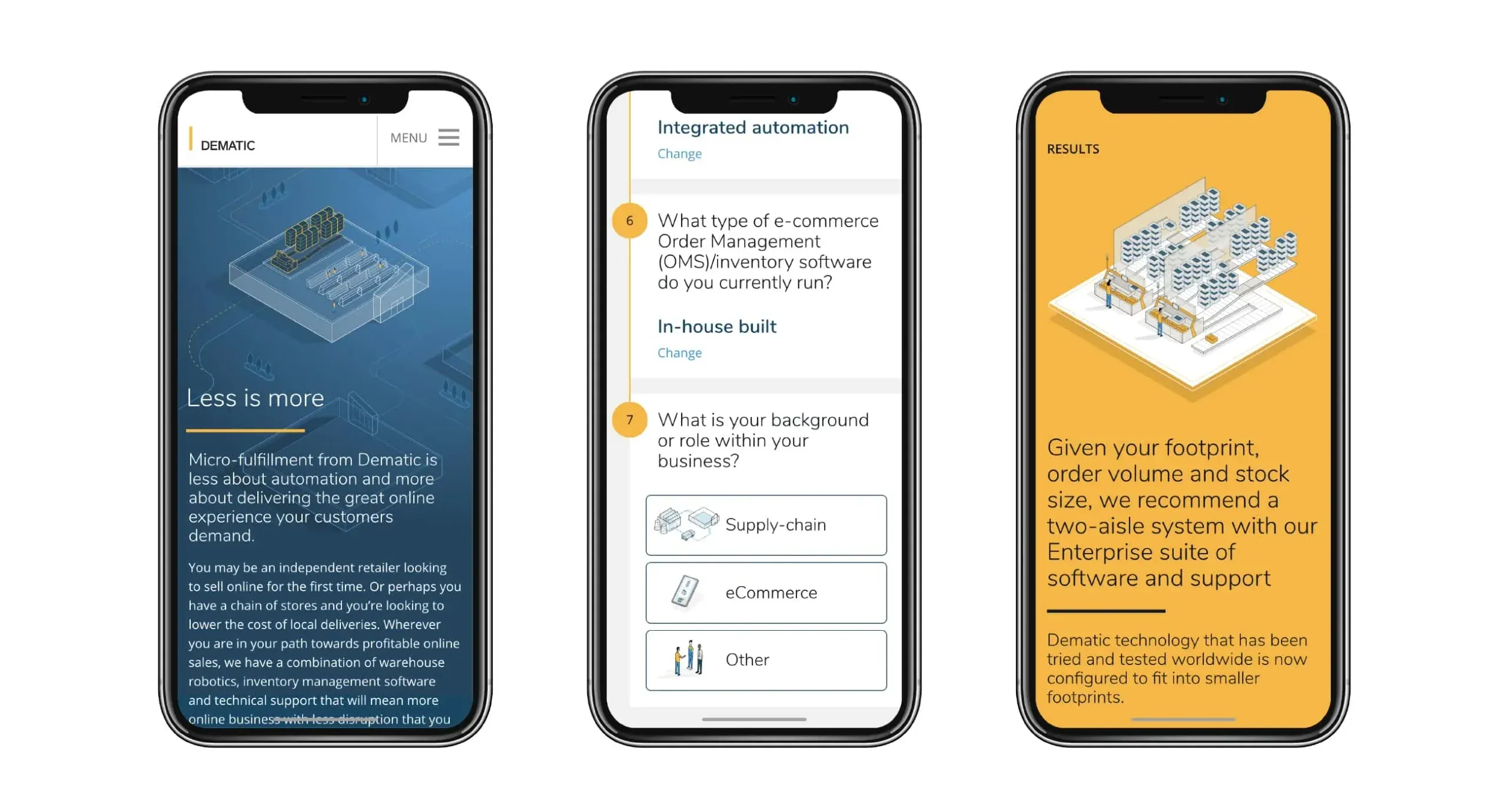
How do we build an interactive campaign that helps users choose?

Build the interactive campaign around one useful choice, then give people a clear route to a personalised answer. A calculator, assessment or configurator works best when each question earns its place, the result is genuinely valuable, and the journey turns complex product information into practical next steps.

A useful choice is the heart of the experience

An interactive campaign helps users choose when it exchanges a small amount of relevant input for a clear, personalised outcome. The format should match the decision people are trying to make. Calculators turn business inputs into a numerical answer. Assessments use targeted questions to produce a report or recommendation. Configurators let people explore a product or service that fits their needs.

The value must be real on both sides. Users get insight, expert guidance or a clearer view of their options. The organisation learns more about the challenges, priorities and needs behind the choice. That creates a feedback loop: responses and interaction patterns can improve the tool, sharpen future content and support more relevant follow-up.

Sources: Everyone’s a winner: exchanging value in B2B marketing

Guide people from broad context to a practical answer

A choice-driven digital experience works best when it starts with the user's situation and reveals detail only when it becomes useful. Begin with a short set of questions that identifies the organisation, role or challenge. Then use clear logic to direct users towards the information, options and practicalities that matter to them.

Keep the content hierarchy simple. Every question should move the user closer to a useful result, rather than asking for data that does not improve the recommendation. Plain language, intuitive interactions and a fast path through the experience reduce friction. Animation and visual design can make complex information easier to explore, but they should support the choice rather than compete for attention. The final result should explain the recommendation and give the user a sensible next action.

Sources: Dematic: A Simple, Powerful Engagement Tool, How to succeed at digital transformation: Influence many different people, Everyone’s a winner: exchanging value in B2B marketing

Keep personalisation clear, accessible and human-checked

An interactive campaign earns trust through clarity, not complexity. Build the experience so users can understand what information they are sharing, why each question matters and how their answer shapes the result. Use accessible, nimble code and make the journey straightforward to navigate across devices.

Generative AI can make recommendations feel less fixed and more relevant to each user's circumstances, but it needs boundaries. Structured rules and trusted content sources keep outputs aligned with the campaign's purpose. Human oversight remains essential for prompt design, content quality, accuracy and the supporting experience around the recommendation. Test the journey before launch, then use user responses to improve the logic, language and content over time.

Sources: UST NavigatorAI: Truly personalised marketing powered by generative AI, Dematic: A Simple, Powerful Engagement Tool, Everyone’s a winner: exchanging value in B2B marketing

The best choice tools make complex decisions feel manageable

We believe an interactive campaign should help people move forward, not simply generate another form completion. That means starting with a real customer decision, making the route through it simple, and giving something useful back. We have built a cyber exposure calculator for Hiscox that helped businesses understand their exposure and its monetary value. For Dematic, we created a straightforward configurator that guided customers through key questions about micro-fulfillment and generated information for sales conversations. We have also developed NavigatorAI for UST, combining structured rules, trusted content and human oversight to deliver tailored recommendations. Our approach keeps the experience clear, useful and grounded in the choices people genuinely need to make.

Sources: Everyone’s a winner: exchanging value in B2B marketing, Dematic: A Simple, Powerful Engagement Tool, UST NavigatorAI: Truly personalised marketing powered by generative AI

FAQs

What type of interactive campaign should we use to help customers choose?

Use a calculator for a numerical answer, an assessment for a tailored report or recommendation, and a configurator for a personalised product or service option. Choose the format based on the decision users need to make, not on the novelty of the interaction. Each format should give users something valuable in return for the information they provide.

How many questions should an interactive choice tool ask?

Ask only the questions needed to create a useful result and guide the next step. A brief, clear journey can help people understand the relevant options without adding unnecessary friction. Questions should improve the recommendation, the information shown or the practical action that follows.

Can generative AI create personalised recommendations in an interactive campaign?

Generative AI can create personalised recommendations when it is guided by structured rules, trusted content sources and relevant user responses. Human oversight should remain part of prompt design, optimisation and content development so the experience stays accurate, engaging and valuable. AI is most useful when it strengthens a clear choice journey rather than replacing the judgement behind it.

How do we improve an interactive campaign after launch?

Use the data people provide and the way they move through the questions to improve the tool over time. Those feedback loops can reveal where content needs more clarity, where logic can become more relevant and what users value most. Better questions can lead to better answers for users and more useful insight for future marketing.