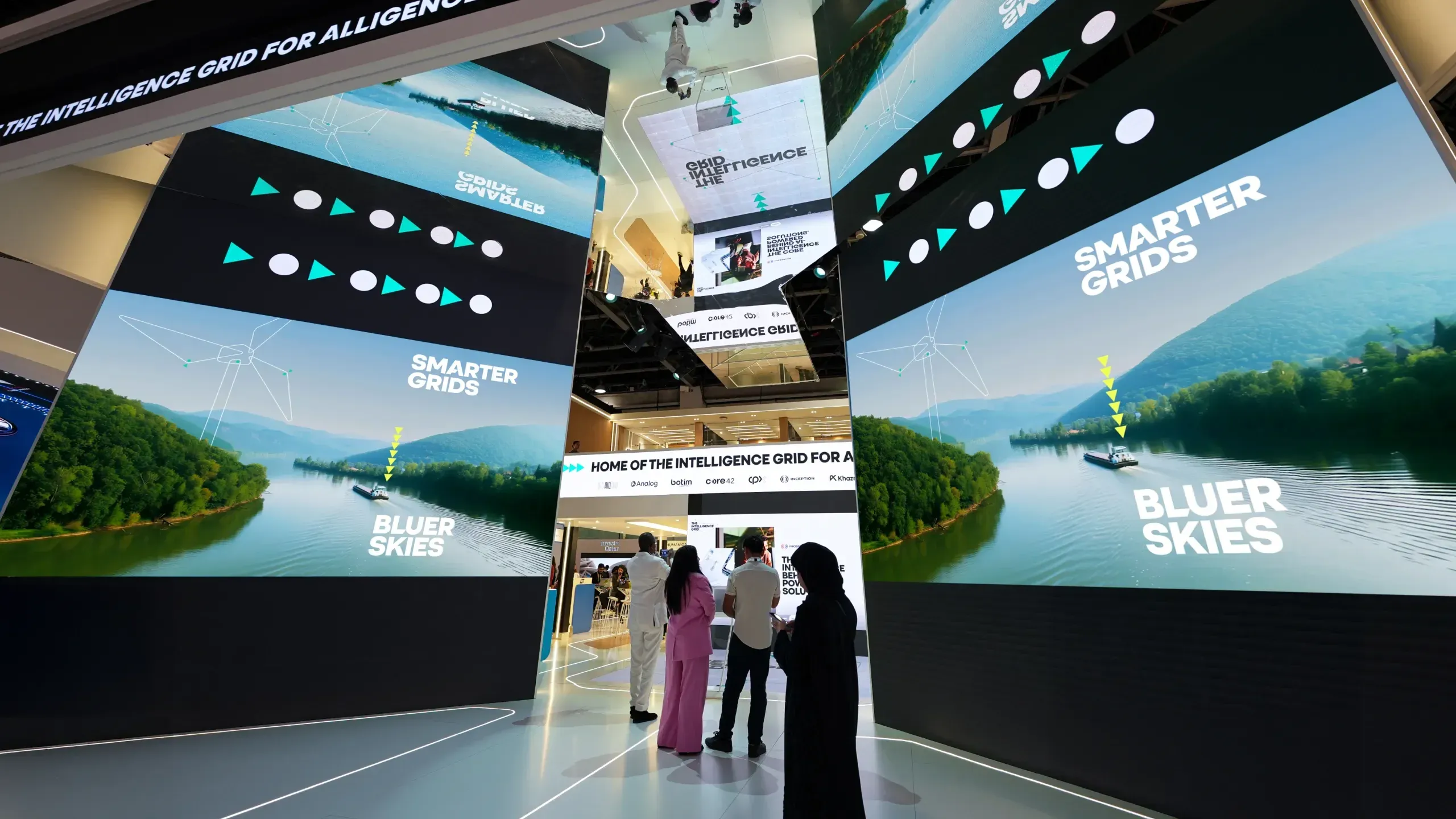
AI capabilities become clearer through applications and commitments
Explaining an AI offering involves more than describing the technology. Audiences need to understand how its capabilities connect to particular industries, what difference they can make to people and which commitments guide their use. The difficulty is making unfamiliar or hard-to-visualise applications understandable without leaving the story at the level of an ambitious future vision. A useful approach is to connect technical capabilities to specific contexts and outcomes, make responsible-use commitments explicit and keep the narrative consistent across the businesses involved. If you use visual storytelling, it should help audiences understand the application, not just attract attention.
For G42, The Intelligence Grid used an "impact algorithm" to connect enablers such as energy, compute, cloud and foundational models with real-world outcomes. Industry stories explained the human impact of technology, while themes including responsible AI, sustainability and equitable AI anchored the experience in G42's purpose. Messaging across all ten group companies was brought into a unified voice, giving a broad technology portfolio a coherent narrative.
For UST, a microsite for its AI services, solutions and platforms needed visuals for difficult-to-demonstrate areas including healthcare and manufacturing. AI-generated imagery depicted tailored, realistic scenarios. This addressed a different communication problem: making application contexts visible when suitable stock photography was difficult to find, with limited time and budget.
Sources: G42: Telling the story of intelligence, Powered by imagination: how I’m making stock imagery creative with AI